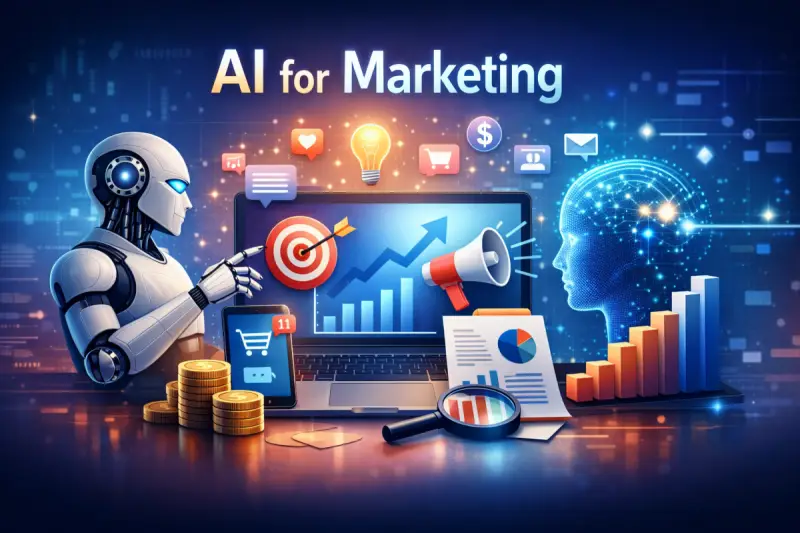
In today’s highly competitive business environment, marketing is one of the most important drivers of business growth. Companies rely on marketing strategies to build brand awareness, reach the right audience, and generate consistent revenue. Without effective marketing, even innovative products and services may struggle to gain visibility in the market.
Over the past decade, the marketing industry has shifted significantly from traditional advertising methods to data-driven digital marketing strategies. Businesses now use websites, social media platforms, search engines, and digital advertising networks to connect with customers across the world. However, managing these channels manually can be extremely complex because marketers must analyze large amounts of data, track consumer behavior, and continuously optimize campaigns.
This is where Artificial Intelligence has become a powerful tool for modern marketing teams. AI technologies allow businesses to analyze massive datasets, understand customer preferences, and predict purchasing behavior with greater accuracy. Companies can now create highly personalized marketing campaigns that target the right audience at the right time.
For example, major companies such as Amazon, Netflix, and Google use AI algorithms to recommend products, content, and advertisements based on user behavior. These intelligent systems analyze browsing history, past purchases, and engagement patterns to deliver personalized experiences that increase conversions and customer satisfaction.
AI is also transforming how businesses run advertising campaigns. Marketing platforms powered by machine learning can automatically optimize ad targeting, adjust bidding strategies, and improve campaign performance in real time. As a result, companies can reduce marketing costs while achieving better results from their digital campaigns.
Artificial Intelligence is helping marketers analyze customer behavior, automate campaigns, and deliver personalized experiences at scale. Many modern marketing platforms now rely on AI to improve targeting, optimize advertising performance, and generate high-quality marketing content.
AI tools help marketers generate blog posts, product descriptions, social media captions, and ad copy faster. Companies use AI writing tools to scale content production while maintaining quality.
Advertising platforms such as Google Ads and Meta Ads use AI algorithms to automatically optimize ad targeting, bidding strategies, and campaign performance.
AI systems analyze large amounts of customer data to understand buying behavior, identify trends, and improve marketing strategies.
AI-powered email marketing platforms automatically segment audiences, personalize email campaigns, and optimize send times to increase engagement.
AI chatbots help businesses provide instant customer support, answer questions, and guide users through the buying process.
AI helps companies recommend products and services based on customer behavior, browsing history, and previous purchases.
AI analyzes customer behavior, browsing patterns, and purchase history to provide deeper insights that help marketers understand their audience better.
AI allows businesses to deliver personalized product recommendations, targeted ads, and customized content based on individual user preferences.
Marketing automation tools powered by AI can schedule campaigns, optimize ads, and automatically adjust strategies based on real-time performance.
AI helps marketers identify the right audience and deliver the right message at the right time, which significantly increases conversion rates.
AI-powered advertising platforms optimize ad targeting, bidding strategies, and creative performance to maximize ROI.
AI systems analyze massive marketing datasets quickly, helping businesses make faster and more informed marketing decisions.

Jasper AI helps marketers generate blog posts, ad copy, social media captions, and marketing content using artificial intelligence.

Copy.ai helps businesses create marketing copy, email campaigns, product descriptions, and social media content quickly.

Writesonic helps marketers generate SEO blog posts, landing pages, and advertising content using AI technology.

Surfer AI helps marketers create SEO optimized content and improve search engine rankings using AI analysis.

HubSpot AI offers marketing automation tools that help businesses manage campaigns, analyze leads, and improve conversions.

Canva AI helps marketers design social media posts, marketing graphics, and ad creatives quickly using AI powered design tools.

Artificial Intelligence is expected to become one of the most powerful technologies shaping the future of digital marketing. Businesses are increasingly relying on AI systems to automate marketing strategies, analyze consumer behavior, and deliver personalized customer experiences at scale.
In the coming years, AI will enable marketers to predict customer needs more accurately and create highly targeted marketing campaigns. Advanced machine learning algorithms will analyze user behavior, search patterns, and engagement data to recommend the right products and services to the right audience.
Large companies like Amazon, Google, and Netflix already use AI-powered recommendation engines to personalize user experiences. These technologies will continue evolving and become even more advanced for businesses of all sizes.
As AI marketing tools become more accessible, small businesses and startups will also be able to use automation, predictive analytics, and intelligent advertising systems to compete with larger companies in the digital marketplace.
Companies like Amazon use AI algorithms to recommend products based on browsing behavior and past purchases. This significantly increases conversions and sales.
Many businesses use AI chatbots to answer customer questions instantly, guide users through the buying process, and improve customer satisfaction.
AI analyzes customer data to predict future buying behavior. Marketers use these insights to create more effective marketing campaigns.
Advertising platforms such as Google Ads use AI to automatically optimize targeting, bidding strategies, and ad performance.
AI helps websites show personalized content, emails, and offers based on individual user preferences and behavior.
AI tools help marketers schedule posts, analyze engagement, and identify the best times to publish content.
While artificial intelligence has transformed digital marketing in many ways, it is important to understand that AI is not a perfect solution for every marketing challenge. Businesses still need human creativity, strategic thinking, and ethical decision-making to build successful marketing campaigns.
One of the biggest challenges is data quality. AI systems depend heavily on large amounts of accurate data to make predictions and recommendations. If the data is incomplete or biased, the AI system may produce misleading insights that can negatively affect marketing decisions.
Another challenge is the lack of human creativity. AI tools can generate marketing content quickly, but they often struggle to produce original ideas that truly connect with human emotions. Successful marketing campaigns still require creative storytelling and brand understanding that humans provide.
Privacy concerns are also becoming more important as AI marketing systems collect and analyze large amounts of customer data. Companies must follow strict data protection regulations and ensure that user information is handled responsibly.
For this reason, the most effective marketing strategies today combine the power of AI technology with human expertise. When businesses use AI as a supporting tool rather than a replacement for human decision-making, they can achieve the best results.
Artificial Intelligence is rapidly becoming a key technology in modern digital marketing. Businesses around the world are investing in AI tools to automate campaigns, improve customer targeting, and increase marketing performance.
of marketers already use AI tools in their marketing strategies.
increase in marketing productivity when AI automation is used.
higher customer engagement through AI-powered personalization.
projected global AI marketing market size by 2028.
AI in marketing refers to the use of artificial intelligence technologies to analyze customer data, automate marketing tasks, personalize campaigns, and improve overall marketing performance.
Businesses use AI for customer segmentation, content creation, email automation, predictive analytics, and advertising optimization.
Yes. Many AI tools such as Jasper, Copy.ai, and Canva AI are designed for small businesses and marketers who want to automate content creation and marketing workflows.
No. AI is designed to assist marketers by automating repetitive tasks and providing data insights. Human creativity and strategy are still essential in marketing.
AI helps businesses analyze customer behavior, improve targeting, automate campaigns, increase marketing efficiency, and deliver personalized customer experiences.