The Future of Technology: How Artificial Intelligence is Changing the World
Artificial Intelligence (AI) is one of the most important technologies of the modern world. It is changing the way people live, work, and communicate. AI allows computers and machines to perform tasks that normally require human intelligence such as learning, decision making, problem solving, and recognizing patterns.
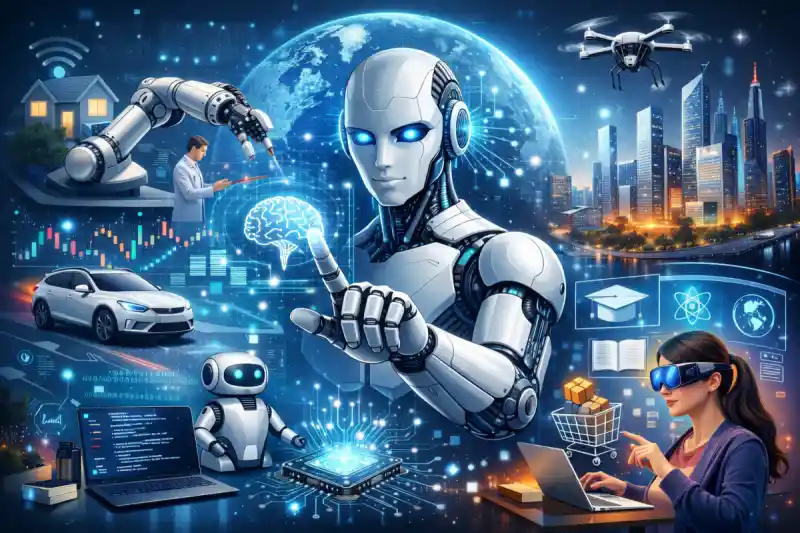
Today AI is used in many areas like healthcare, banking, education, transportation, online shopping, and social media. From voice assistants like Siri and Google Assistant to recommendation systems on YouTube and Netflix, AI is everywhere. As technology continues to grow, AI will become even more powerful and will transform the future of society.
What is Artificial Intelligence?
Artificial Intelligence is a branch of computer science that focuses on creating machines that can think and learn like humans. These machines use algorithms and large amounts of data to analyze information, find patterns, and make decisions.
Unlike traditional computer programs that follow fixed instructions, AI systems can learn from experience and improve over time. This ability is known as machine learning, which is one of the core technologies behind modern AI systems.
Types of Artificial Intelligence
AI can be divided into different types depending on its capabilities and complexity. Some AI systems are designed for specific tasks, while others aim to perform multiple human-like functions.
| Type of AI | Description | Example |
|---|---|---|
| Narrow AI | AI designed to perform a specific task. | Voice assistants, recommendation systems |
| General AI | AI that can perform any intellectual task like humans. | Still under research |
| Super AI | AI that surpasses human intelligence. | Theoretical concept |
How Artificial Intelligence Works
AI works by collecting and analyzing large amounts of data. This data is processed using complex algorithms that help machines identify patterns and make predictions. The more data an AI system receives, the better it becomes at performing its tasks.
Machine learning and deep learning are two important techniques used in AI development. Machine learning allows systems to learn from data, while deep learning uses neural networks that mimic the human brain to process complex information.
Applications of Artificial Intelligence
Artificial Intelligence is used in many industries and continues to expand into new areas. Some of the most common applications include:
| Industry | AI Application | Benefit |
|---|---|---|
| Healthcare | Disease detection and medical imaging | Faster and more accurate diagnosis |
| Finance | Fraud detection and automated trading | Improved security and efficiency |
| Education | Personalized learning systems | Better learning experience |
| E-commerce | Product recommendations | Improved customer satisfaction |
Advantages of Artificial Intelligence
AI offers many advantages that make it valuable in modern society. It can process large amounts of data quickly, reduce human errors, and automate repetitive tasks. This helps businesses increase productivity and efficiency.
AI also helps in solving complex problems in areas such as climate research, medicine, and scientific discoveries. With continuous improvements, AI has the potential to make many industries smarter and more efficient.
Challenges and Concerns
Despite its benefits, AI also raises several challenges. One major concern is job displacement, as automation may replace certain human jobs. There are also concerns about data privacy, security, and ethical use of AI technology.
To ensure responsible development, governments and organizations are working on creating guidelines and regulations for AI systems. Proper management and ethical use of AI will help society benefit from this technology while minimizing risks.
The Future of Artificial Intelligence
The future of AI looks very promising. Researchers are working on developing smarter systems that can assist humans in almost every field. In the coming years, AI may play a major role in building smart cities, improving healthcare systems, and creating new innovations in science and technology.
As AI continues to evolve, it will become an essential part of everyday life. Understanding and adapting to this technology will be important for individuals and businesses who want to succeed in the digital world.